THE WORKS OF PJF

Farmer did not do a lot of reviewing over his long career, when he did it was usually at the request of an editor or publisher. This page was created in July 2003 in honor of discovering the review he wrote for The New York Times Book Review in 1984, that we did not learn of until 2003. The other four reviews had been on the articles page. One month later we discovered the first review below, in Science Fiction Review #39.
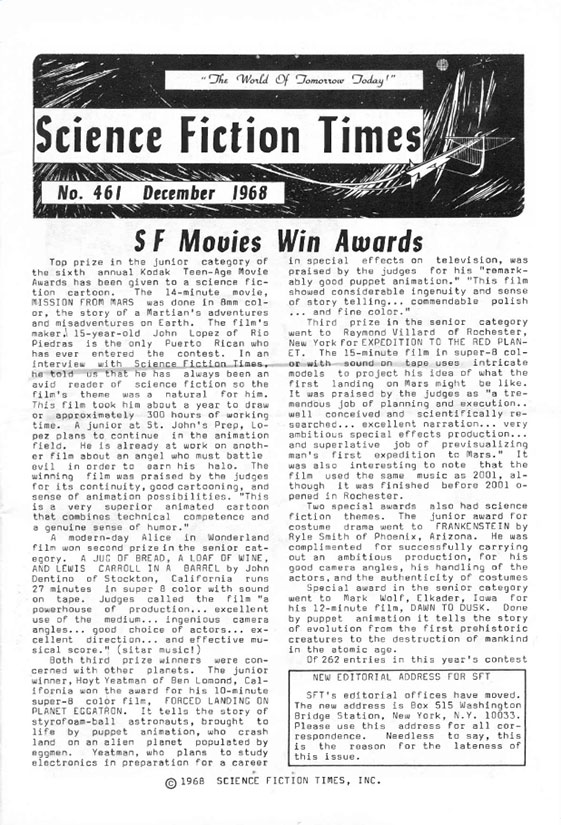
A Writer and a Fan View a New Magazine
WORLDS OF FANTASY, vol.l no.l. Galaxy Pub. Corp., 1968. 60¢
It is unfortunate that the first issue of this new magazine will be the last (according to what I heard from Fred Pohl on Labor Day). This magazine could have been the long long awaited avatar of Unknown Worlds. Second avatar, that is, because Horace Gold was responsible for the first with his Beyond. I do not remember why Gold's fantasy magazine failed, but it could not have been because of lack of excellent stories. Worlds of Fantasy apparently came into ruinous contact with the reality of distribution, or, I should say, the fantasy of distribution. Chaos may be a better word. Shipwrecked, Worlds of Fantasy sinks, and I feel sad.
Not so much because this first issue is an emerald in the crown of the Princess of Oz. It is not. It is a collection of fairly entertaining and sometimes amusing stories. The most scintillating features are the editorial by Lester del Rey and his article on Tolkien. There is a Conan story and several Conan-like stories and a vampire story reminiscent of Weird Tales (but with a novel angle) and a fantasy about death and several stories whose essence is that of Unknown Worlds. But I'm certain that, given enough time and enough publicity to bring a large number of authors (everybody loves to write fantasy) and enough thought for shaping a del Rey-type editorship, Worlds of Fantasy could have developed into something to look forward to with delight. It is a pity that the magazine did not make it. – Philip Jose Farmer
(Editor's note: According to Fred Pohl at Philcon, the fate of Worlds of Fantasy is still undecided. Sales figures should be in by the end of the year and the final decision will be made then.)
- Science Fiction Times No. 461, December 1968 (First appearance)
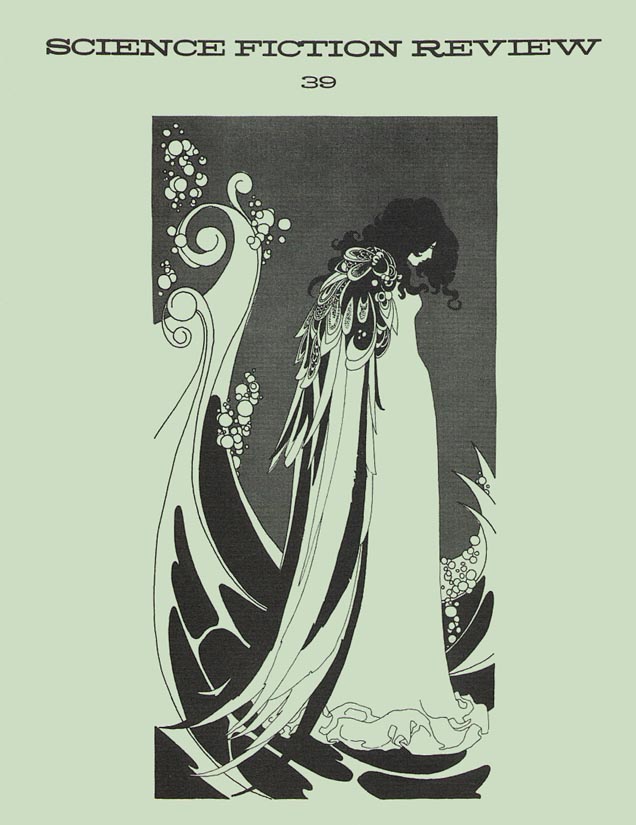
Review of THE PROMETHEUS PROJECT by Gerald Feinberg
In his review of this non-fiction book, Farmer talks about the authors intent, that before scientists go off and develop potentially world changing technologies like; atomic energy , cloning, etc. questions should be asked about if these technologies should be developed. Perhaps even letting the country vote on it before allowing the research to happen. He then says that he has a hard time taking the author seriously because he states that he doesn't think we currently face any problems that won't be solved over the next few years by science.
- Science Fiction Review #39, August 1970 (First appearance)
- PEARLS FROM PEORIA, Subterranean Press, 2006 hardcover
Getting A-Long with Heinlein
Farmer writes a long review of Heinlein's TIME ENOUGH FOR LOVE. He also discusses the phases of Heinlein's writing style.
- Moebius Trip Library #19, January 1974 (First appearance)
- PEARLS FROM PEORIA, Subterranean Press, 2006 hardcover
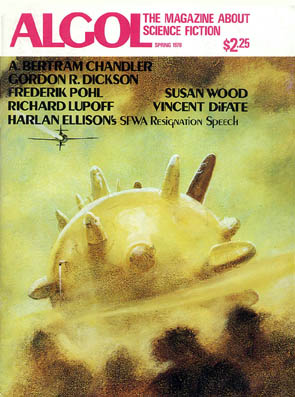
Farmer's Lupoff Week
Farmer turns book critic but spends most of his ink criticizing publishers, editors and cover artists. Eventually he gives a luke warm review of Chrysalis vol 1. Farmer's The Last Rise of Nick Adams appears in Chrysalis vol 2.
- Algol, Spring 1978 (First appearance)
- Also appeared as A Review of 1977 Anthology Chrysalis in: PEARLS FROM PEORIA, Subterranean Press, 2006 hardcover
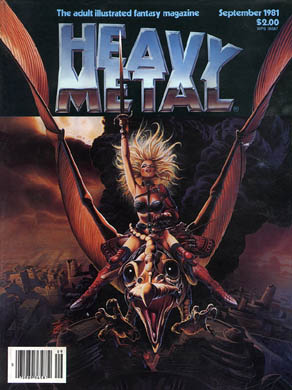
Farmer on Wilson by Robert Anson Wilson
In this article Farmer discusses/reviews the Illuminatus Trilogy. It appears along side Wilson on Farmer.
- Heavy Metal #54, September 1981 (First appearance)
- Also appeared as God't Hat in: PEARLS FROM PEORIA, Subterranean Press, 2006 hardcover
Pornograms and Supercomputers
Farmer reviews IMAGINARY MAGNITUDE by Stanislaw Lem. Farmer praises the inventiveness of this book, which is not a novel but a collecion of introductions to books that don't exist. He comments on Lem's major themes that run through the book; that there are a lot of things in the universe that man will never understand, and that machines will someday be equal or superior to their makers.
- New York Times Book Review, September 2 1984 (First appearance)
- PEARLS FROM PEORIA, Subterranean Press, 2006 hardcover
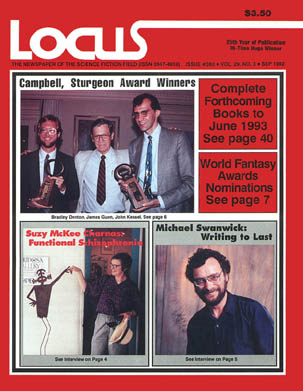
Review of HOW THE WIZARD CAME TO OZ
A short postive review of this nostalgic book.
- Locus #380, September 1992 (First appearance)
- PEARLS FROM PEORIA, Subterranean Press, 2006 hardcover